 Add to Chrome
 Add to Firefox
 Add to Edge
Policy-based Foveated Imaging and Perception
Jun 01, 2026
Ultra-high-resolution image sensors offer the potential to capture fine spatial details critical for many visual perception tasks, but acquiring and processing all pixels at full resolution is often infeasible under realistic bandwidth, latency, and power constraints. Existing approaches address this challenge through acquisition strategies such as spatial or temporal downsampling, which irrevocably discard information before task relevance can be assessed. In this work, we introduce a real-time, predictive, and task-aware foveated imaging system that operates directly at image acquisition time. Leveraging emerging dual-stream sensor architectures, our method dynamically allocates limited pixel bandwidth to task-relevant regions of interest while maintaining a low-resolution global context. We formulate foveated acquisition as a sensor attention policy-learning problem, in which past observations guide actions that determine future measurements, closing the perception-acquisition loop. Through extensive simulation across multiple perception tasks, we demonstrate that our approach achieves high task performance under strict pixel budgets and significantly outperforms relevant baselines operating at the same bandwidth. We further validate our system on a 200-megapixel dual-stream sensor, capturing real-world videos under realistic bandwidth and latency constraints, demonstrating the practical feasibility of task-driven, acquisition-time foveated imaging.

GeoFlow: Enforcing Implicit Geometric Consistency in Video Generation
May 18, 2026Generating geometrically consistent videos remains an open challenge: text-to-video diffusion models trained on web-scale data treat geometry only implicitly, leading to object deformation, texture drift, and non-rigid backgrounds under camera motion. Existing solutions either improve consistency as a byproduct, apply only to static scenes or realign the latent space of the model completely. We introduce a geometry-consistency reward that directly measures whether motion in a generated video is compatible with a coherent scene. Our key insight is that in physically consistent videos, background motion should be explainable by rigid camera-induced flow, while independently moving objects should preserve appearance identity along motion trajectories. We operationalize this using optical flow, depth--pose predictions, and feature-based correspondence to separate rigid and dynamic regions and evaluate their respective consistency. Integrating this reward with reinforcement fine-tuning transforms geometric consistency from an emergent property into an explicit optimization objective for video generators. The approach is model agnostic and applies to diverse dynamic scenes containing both camera and object motion. Experiments show substantial reductions in temporal geometric artifacts over strong baselines while preserving perceptual quality. Code and model weights are published.
Asymmetric Flow Models
May 13, 2026Flow-based generation in high-dimensional spaces is difficult because velocity prediction requires modeling high-dimensional noise, even when data has strong low-rank structure. We present Asymmetric Flow Modeling (AsymFlow), a rank-asymmetric velocity parameterization that restricts noise prediction to a low-rank subspace while keeping data prediction full-dimensional. From this asymmetric prediction, AsymFlow analytically recovers the full-dimensional velocity without changing the network architecture or training/sampling procedures. On ImageNet 256$\times$256, AsymFlow achieves a leading 1.57 FID, outperforming prior DiT/JiT-like pixel diffusion models by a large margin. AsymFlow also provides the first-ever route for finetuning pretrained latent flow models into pixel-space models: aligning the low-rank pixel subspace to the latent space gives a seamless initialization that preserves the latent model's high-level semantics and structure, so finetuning mainly improves low-level mismatches rather than relearning pixel generation. We show that the pixel AsymFlow model finetuned from FLUX.2 klein 9B establishes a new state of the art for pixel-space text-to-image generation, beating its latent base on HPSv3, DPG-Bench, and GenEval while qualitatively showing substantially improved visual realism.
DeepSearchQA: Bridging the Comprehensiveness Gap for Deep Research Agents
Jan 28, 2026We introduce DeepSearchQA, a 900-prompt benchmark for evaluating agents on difficult multi-step information-seeking tasks across 17 different fields. Unlike traditional benchmarks that target single answer retrieval or broad-spectrum factuality, DeepSearchQA features a dataset of challenging, handcrafted tasks designed to evaluate an agent's ability to execute complex search plans to generate exhaustive answer lists. This shift in design explicitly tests three critical, yet under-evaluated capabilities: 1) systematic collation of fragmented information from disparate sources, 2) de-duplication and entity resolution to ensure precision, and 3) the ability to reason about stopping criteria within an open-ended search space. Each task is structured as a causal chain, where discovering information for one step is dependent on the successful completion of the previous one, stressing long-horizon planning and context retention. All tasks are grounded in the open web with objectively verifiable answer sets. Our comprehensive evaluation of state-of-the-art agent architectures reveals significant performance limitations: even the most advanced models struggle to balance high recall with precision. We observe distinct failure modes ranging from premature stopping (under-retrieval) to hedging behaviors, where agents cast an overly wide net of low-confidence answers to artificially boost recall. These findings highlight critical headroom in current agent designs and position DeepSearchQA as an essential diagnostic tool for driving future research toward more robust, deep-research capabilities.
Image2Garment: Simulation-ready Garment Generation from a Single Image
Jan 15, 2026Estimating physically accurate, simulation-ready garments from a single image is challenging due to the absence of image-to-physics datasets and the ill-posed nature of this problem. Prior methods either require multi-view capture and expensive differentiable simulation or predict only garment geometry without the material properties required for realistic simulation. We propose a feed-forward framework that sidesteps these limitations by first fine-tuning a vision-language model to infer material composition and fabric attributes from real images, and then training a lightweight predictor that maps these attributes to the corresponding physical fabric parameters using a small dataset of material-physics measurements. Our approach introduces two new datasets (FTAG and T2P) and delivers simulation-ready garments from a single image without iterative optimization. Experiments show that our estimator achieves superior accuracy in material composition estimation and fabric attribute prediction, and by passing them through our physics parameter estimator, we further achieve higher-fidelity simulations compared to state-of-the-art image-to-garment methods.
The FACTS Leaderboard: A Comprehensive Benchmark for Large Language Model Factuality
Dec 11, 2025We introduce The FACTS Leaderboard, an online leaderboard suite and associated set of benchmarks that comprehensively evaluates the ability of language models to generate factually accurate text across diverse scenarios. The suite provides a holistic measure of factuality by aggregating the performance of models on four distinct sub-leaderboards: (1) FACTS Multimodal, which measures the factuality of responses to image-based questions; (2) FACTS Parametric, which assesses models' world knowledge by answering closed-book factoid questions from internal parameters; (3) FACTS Search, which evaluates factuality in information-seeking scenarios, where the model must use a search API; and (4) FACTS Grounding (v2), which evaluates whether long-form responses are grounded in provided documents, featuring significantly improved judge models. Each sub-leaderboard employs automated judge models to score model responses, and the final suite score is an average of the four components, designed to provide a robust and balanced assessment of a model's overall factuality. The FACTS Leaderboard Suite will be actively maintained, containing both public and private splits to allow for external participation while guarding its integrity. It can be found at https://www.kaggle.com/benchmarks/google/facts .
Towards Vision-Language-Garment Models For Web Knowledge Garment Understanding and Generation
Jun 05, 2025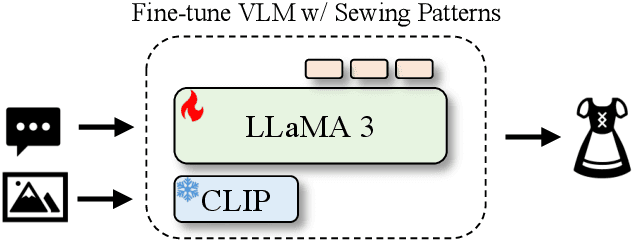
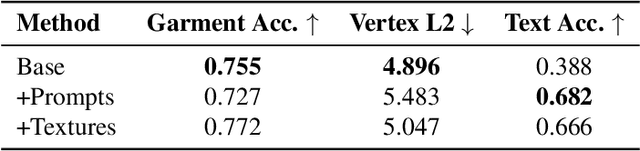
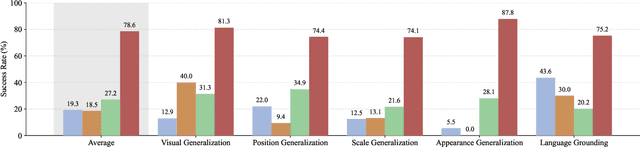
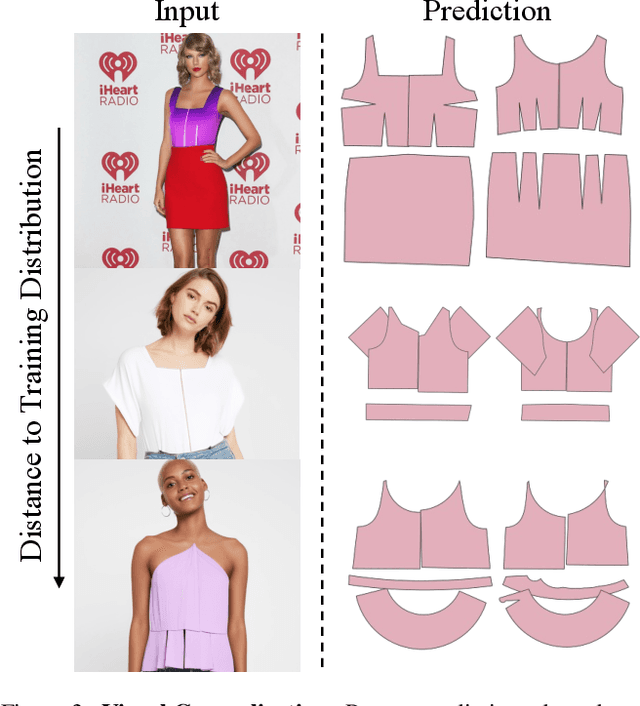
Multimodal foundation models have demonstrated strong generalization, yet their ability to transfer knowledge to specialized domains such as garment generation remains underexplored. We introduce VLG, a vision-language-garment model that synthesizes garments from textual descriptions and visual imagery. Our experiments assess VLG's zero-shot generalization, investigating its ability to transfer web-scale reasoning to unseen garment styles and prompts. Preliminary results indicate promising transfer capabilities, highlighting the potential for multimodal foundation models to adapt effectively to specialized domains like fashion design.
AIpparel: A Large Multimodal Generative Model for Digital Garments
Dec 05, 2024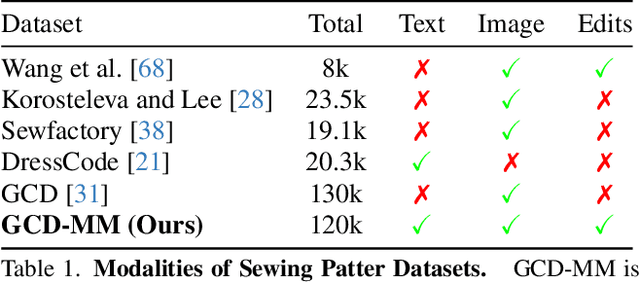
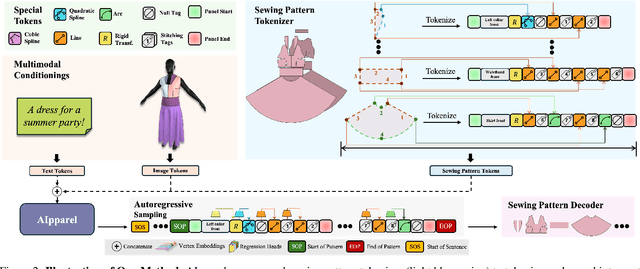

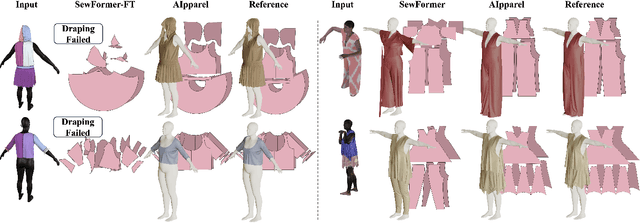
Apparel is essential to human life, offering protection, mirroring cultural identities, and showcasing personal style. Yet, the creation of garments remains a time-consuming process, largely due to the manual work involved in designing them. To simplify this process, we introduce AIpparel, a large multimodal model for generating and editing sewing patterns. Our model fine-tunes state-of-the-art large multimodal models (LMMs) on a custom-curated large-scale dataset of over 120,000 unique garments, each with multimodal annotations including text, images, and sewing patterns. Additionally, we propose a novel tokenization scheme that concisely encodes these complex sewing patterns so that LLMs can learn to predict them efficiently. \methodname achieves state-of-the-art performance in single-modal tasks, including text-to-garment and image-to-garment prediction, and enables novel multimodal garment generation applications such as interactive garment editing. The project website is at georgenakayama.github.io/AIpparel/.
Do Efficient Transformers Really Save Computation?
Feb 21, 2024As transformer-based language models are trained on increasingly large datasets and with vast numbers of parameters, finding more efficient alternatives to the standard Transformer has become very valuable. While many efficient Transformers and Transformer alternatives have been proposed, none provide theoretical guarantees that they are a suitable replacement for the standard Transformer. This makes it challenging to identify when to use a specific model and what directions to prioritize for further investigation. In this paper, we aim to understand the capabilities and limitations of efficient Transformers, specifically the Sparse Transformer and the Linear Transformer. We focus on their reasoning capability as exhibited by Chain-of-Thought (CoT) prompts and follow previous works to model them as Dynamic Programming (DP) problems. Our results show that while these models are expressive enough to solve general DP tasks, contrary to expectations, they require a model size that scales with the problem size. Nonetheless, we identify a class of DP problems for which these models can be more efficient than the standard Transformer. We confirm our theoretical results through experiments on representative DP tasks, adding to the understanding of efficient Transformers' practical strengths and weaknesses.
Maskomaly:Zero-Shot Mask Anomaly Segmentation
May 26, 2023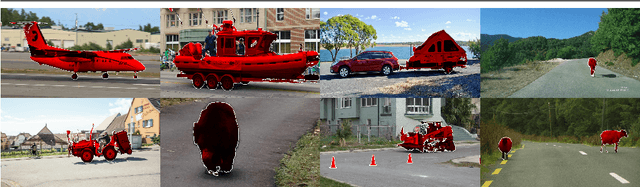
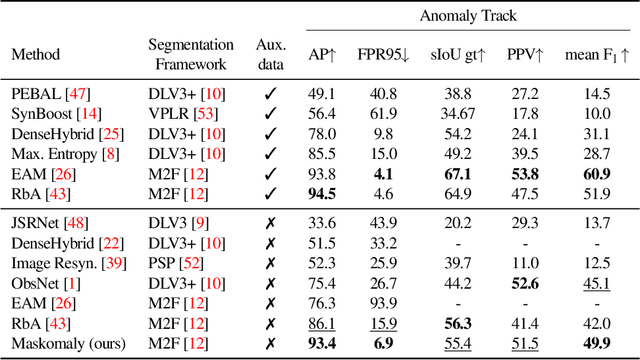
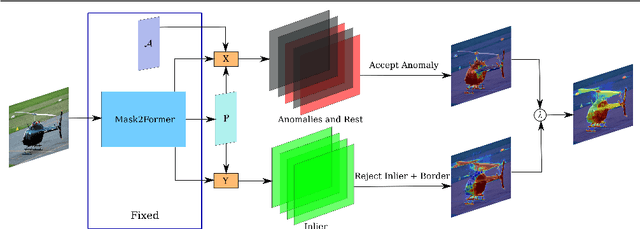
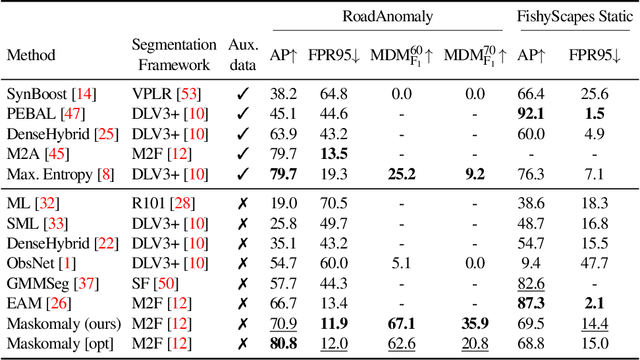
We present a simple and practical framework for anomaly segmentation called Maskomaly. It builds upon mask-based standard semantic segmentation networks by adding a simple inference-time post-processing step which leverages the raw mask outputs of such networks. Maskomaly does not require additional training and only adds a small computational overhead to inference. Most importantly, it does not require anomalous data at training. We show top results for our method on SMIYC, RoadAnomaly, and StreetHazards. On the most central benchmark, SMIYC, Maskomaly outperforms all directly comparable approaches. Further, we introduce a novel metric that benefits the development of robust anomaly segmentation methods and demonstrate its informativeness on RoadAnomaly.